
Written by the McBride Health editorial team · Updated November 28, 2026 · Facts checked against the U.S. Physical Activity Guidelines, the American College of Sports Medicine, and a Cochrane review of stretching before exercise
Key takeaways
- Ten minutes covers the areas that limit most people: hip flexors, ankles and the mid-back.
- Move first, hold later. Dynamic drills before training, static stretches after.
- Mobility adds range and comfort. It does not bulletproof a joint, and the injury-prevention evidence is thinner than the internet claims.
- Frequency beats duration. Five short sessions a week do more than one long one.
- Pinching, locking, numbness or swelling is not a mobility problem. Get it looked at.
What Ten Minutes Can and Can’t Do
A reader named Dana, 43, sent me a video of her deadlift last spring. The bar path was fine. Her lower back rounded at the bottom of every rep, and her heels came about an inch off the floor.
She had spent six weeks on a foam roller. Forty minutes at a time. It felt good and changed nothing.
Two ankle drills and one hip drill fixed the heel lift in eleven days. Not because rolling is useless, but because she was rolling tissue that wasn’t the bottleneck and never asked the joint to move under a load.
That’s the idea behind a short mobility block. You’re not chasing a split. You’re asking three or four joints to do their job while you’re fresh, so they can still do it when there’s a bar on your back or a hill under your feet.
Now the part most articles skip. Mobility work reliably improves range of motion. Whether it prevents injury is a much weaker claim. If a friend told me ten minutes of hip work prevents most injuries, I’d push back. Most training injuries trace back to a jump in load, not to stiff hips. Mobility helps you tolerate the load you’re asking for. It doesn’t replace sane programming.
The Three Areas That Steal Your Range
Hips, ankles, mid-back. That’s the short list. Knees and shoulders get blamed for problems that start one joint away.
Start with the ankle. Stand with your toes four inches from a wall and drive your knee toward it without lifting your heel. If your knee stops well short of the wall, or your arch collapses, your squat depth and your stride are paying for it. The knee-to-wall test is crude and useful. Ten centimeters, about four inches, is a common target.
Hips come next. Sitting shortens the hip flexors and quietly kills internal rotation. You notice it as a pinch at the front of the hip at the bottom of a squat, or a lower back that rounds before your hamstrings ever feel a stretch.
The mid-back is the one people forget. If your thoracic spine won’t extend or rotate, your shoulders and lower back split the difference. That’s how a shoulder problem starts in a desk chair.
Here’s a quick screen for each, plus a drill that fits the ten-minute block.
| Area | Quick check | Drill, 30 to 60 seconds |
|---|---|---|
| Hip flexors | Lie on your back and pull one knee to your chest. Does the other thigh stay down? | Half-kneeling hip flexor reach, 8 slow reps per side |
| Hip rotation | Sit cross-legged. One knee sits much higher than the other. | 90/90 switches, 8 per side, hands behind you for support |
| Ankles | Knee-to-wall test with the heel down. How close does the knee get? | Ankle rocks, then slow calf raises, 10 each |
| Mid-back | Stand with your back to a wall, ribs down, arms overhead. Do your wrists leave the wall? | Open book rotation, 6 slow breaths per side |
None of these are tests you can fail. They’re information. A joint that scores badly on Monday is the one you bias for the next two weeks.
Dynamic First, Static Later
Static stretching before a hard effort isn’t the villain it was made out to be a decade ago. But it isn’t a warm-up either.
Long holds on a cold muscle temporarily reduce how much force it can produce. The drop is small and short lived. It matters if you’re about to sprint or take a heavy single. It matters a lot less before a thirty-minute easy run.
What does help is heat and rehearsal. Ten leg swings. Eight walking lunges. A minute of ankle rocks and arm circles. That raises tissue temperature and walks the joint through the range you’re about to use.
The Cochrane review on stretching is worth reading if you enjoy disappointing news. Pooled trials found that stretching before exercise did not reduce muscle soreness, and didn’t show a useful reduction in injury risk. Stretching afterward didn’t clearly prevent soreness either. What stretching does do is increase range of motion. That’s a real benefit. It just isn’t armor.
So the split is simple. Dynamic work goes before. Longer static holds go after, when your goal is range rather than performance.
The Ten-Minute Block
Ten minutes is enough to touch every area once and still get to your first set warm.
Start with whatever is stiffest that day. If you’re short on time, cut drills before you cut frequency.
Here’s the version I’d hand a client who trains three or four days a week.
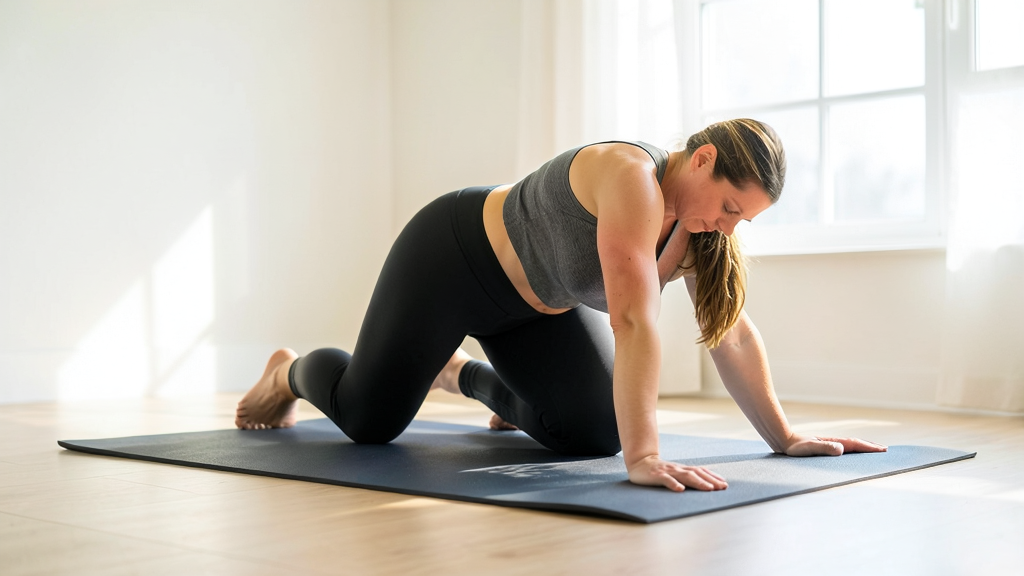
- Put the mat where you already train. Not in another room.
- Set a ten-minute timer. Stop when it goes off, even mid-drill.
- Do one hip drill, one ankle drill and one mid-back drill. Three is enough.
- Add a deep squat hold for 30 seconds at the end, and breathe.
- Finish with two easy sets of the movement you’re about to load.
- Pick one joint to bias each week and leave the others on maintenance.
- Log it for two weeks. If the numbers on your main lift don’t move, change the drills, not the habit.
Mobility work that never touches your training is a hobby. Ten minutes earns its place when your squat gets deeper, your stride gets longer, or your shoulder stops complaining on overhead days.
Range of motion should feel like a stretch, not a threat. If a drill produces a pinch at the front of the hip or a sharp catch in the ankle, back off and change the angle. Grinding into a block is how people turn a stiff joint into an angry one.
When to See a Doctor
Most stiffness is boring and responds to a few weeks of consistent work. Some things aren’t boring.
See a doctor if pain wakes you at night, or if a joint swells without a clear injury.
See a doctor if a joint locks, catches, or gives way, or if you have numbness, tingling or weakness in an arm or leg. Pain that shoots below the knee or below the elbow is a nerve question, not a flexibility question.
Go now, not next month, for back pain with fever, unexplained weight loss, or any change in bladder or bowel control. Those are rare and serious. Chest pain, faintness or shortness of breath during exercise is a call for emergency help, full stop.
And see someone if pain keeps getting worse across two or three weeks of easier training. That pattern is a signal that the load, not the tissue, needs a second opinion.
Sources
- U.S. Department of Health and Human Services. Physical Activity Guidelines for Americans, 2nd edition. health.gov
- American College of Sports Medicine. Flexibility exercise guidance and position stands. acsm.org
- Herbert RD, Gabriel M. Effects of stretching before and after exercising on muscle soreness and risk of injury. Cochrane Database of Systematic Reviews. cochranelibrary.com
- American Academy of Orthopaedic Surgeons. OrthoInfo: Staying Healthy. orthoinfo.aaos.org
- MedlinePlus, U.S. National Library of Medicine. Exercise and Physical Fitness. medlineplus.gov
- National Health Service. Exercise. nhs.uk
This article is for general information and is not medical advice. It can’t account for your history, your joints or your training load. Talk with a licensed clinician or a qualified coach before changing a routine, especially if you have an injury that’s still healing, a joint that has been operated on, or pain that hasn’t settled.
Related reading: More fitness guides from McBride Health